Nassim Nicholas Taleb gave us one of the most useful modern ways to think about uncertainty. Fooled by Randomness, The Black Swan and Antifragile changed how many people understood risk, prediction and the weakness of systems that appear stable until something unexpected happens.
I had no interest in repeating that work. My question came later: what do you actually do when uncertainty is already part of everyday life?
In practice, uncertainty quickly breaks into different problems. Sometimes you lack information. Sometimes you have the information but no authority to act. You may have authority but not enough money, people or time. A company may have all of these and still be unable to use them because its internal processes no longer work. And sometimes the organization is functioning while everyone inside it is waiting for conditions to return to normal.
These problems may look similar from outside. They require very different decisions.
So I divided the larger problem into six zones and began building practical frameworks for each of them: uncertainty, responsibility, constraint, decision architecture, the operator, and permanent crisis.
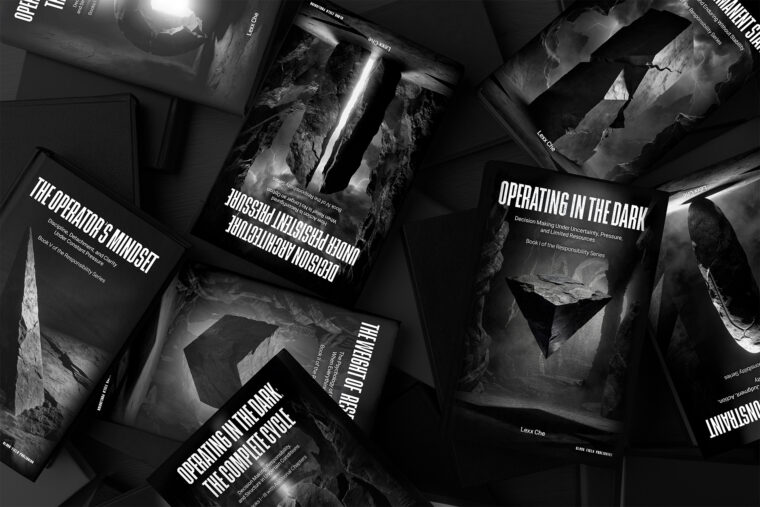
This became the six-book core of Operating in the Dark.
Why This Matters More Now
Uncertainty is obviously not new. What has changed is how quickly problems move between systems.
A war affects energy, logistics, prices and investment. A technological breakthrough changes jobs, markets and competition. A political decision in one country can affect companies thousands of kilometers away. Information travels almost instantly, while governments and organizations may need months or years to adapt. AI is accelerating another major transformation while many companies are still dealing with the consequences of the previous digital one.
For managers, founders and other decision-makers, this means several forms of instability can arrive at the same time.
The old model was relatively simple: a crisis interrupts normal life, you manage the crisis, and eventually normal life returns. I am increasingly skeptical that this is a useful assumption for the world we are entering.
I wrote the Operating in the Dark books during the war in Ukraine. Air attacks, power outages and the everyday consequences of war were part of the environment in which I was writing.
The ideas themselves began much earlier, through years of working with teams, companies, products and complex systems. War did something else: it made many abstract management ideas very concrete.
A deadline still exists during a blackout. A colleague may suddenly become unavailable because personal safety matters more than the project. Infrastructure that seemed permanent yesterday can disappear today. International clients continue working according to their normal calendars while your own environment has changed completely.
You quickly discover which parts of your system actually work under pressure.
Six Problems Behind the Six Books
The first book, Operating in the Dark, deals with uncertainty. The central question is practical: how much information do you really need before acting? Waiting can give you better information, but waiting also has a cost. Markets move, opportunities disappear and conditions change. At some point, waiting for certainty becomes a decision itself.
The Weight of Responsibility moves to responsibility. Once a specific manager is responsible for the result, the problem changes. Difficult decisions tend to move upward. Strong leaders can slowly become bottlenecks because everyone expects them to solve every serious problem. Responsibility therefore has to be designed into the system rather than simply demanded from individuals.
Decision Under Constraint deals with limits. A brilliant strategy is useless if the company does not have the money, people, authority, infrastructure or time to execute it. Constraints should not appear at the end as excuses for failure. They should shape the strategy from the beginning.
The fourth book, Decision Architecture Without Relief, looks at the system producing the decisions. If several capable people repeatedly fail in the same place, the problem may not be the people. Information may be reaching the wrong level. Managers may have responsibility without real authority. Processes created for a small company may stop working after it grows. Replacing another manager will not repair that architecture.
The Operator’s Mindset focuses on the person inside the system. Attention is limited. People become tired. Experience helps, but previous success can also make new problems harder to see. The operator needs to filter information, protect attention and understand which decisions genuinely require intervention.
Finally, Crisis as a Permanent State asks what happens when the crisis does not end.
Many organizations can work under extreme pressure for a few months because everyone believes normal conditions will eventually return. People work harder. Temporary processes are accepted. Problems are postponed. Reserves are spent.
But what happens when temporary conditions last for years?
Living and working through war has made the phrase “when things return to normal” particularly important to me. I no longer hear it as a promise. I hear it as an assumption that needs to be tested.
The same question applies far beyond Ukraine. Companies wait for markets to normalize. Industries wait for regulation to become predictable. Organizations wait for technological change to slow down. Governments wait for political stability.
Sometimes stability returns. The danger is building a system that can survive only if it does.
Breaking the System Apart — and Putting It Back Together
The six books follow a deliberate sequence.
Uncertainty leads to responsibility. Responsibility meets constraints. Repeated constraints expose problems in the decision system. That system cannot be understood without looking at the person operating inside it. And everything changes again when instability becomes permanent.
After separating the problem into six books, I wanted to put it back together.
That is the purpose of Books Seven and Eight.
Operating in the Dark: The First Cycle combines the first three books — uncertainty, responsibility and constraint — with additional chapters and conclusions.
Operating in the Dark: The Complete Cycle brings together the second half — decision architecture, the operator and permanent crisis — again with additional material and conclusions.
They are more than collections. The first six books examine individual parts of the problem. Books Seven and Eight show how those parts work together.
Then I deliberately moved in a different direction.
Why Responsibility: Anti-Coaching Stands Apart
Responsibility: Anti-Coaching — Principles, Logic, Frameworks, and Applied Cases takes the ideas from the series and puts them back into real situations.
The book moves through business during war, international expansion, institutional information systems, humanitarian work, corporate problems and high-performance sport. These situations are messy because real systems are messy. Information arrives late. People get tired. Budgets change. Decisions create unexpected consequences. Solving one problem can create another.
This is also where my Anti-Coaching approach becomes important.
Over the years, I noticed that many problems described as personal failures were actually system failures.
A manager is told to become more confident when they do not have the authority to make the decision. A team is told to become more motivated when it does not have enough resources. A leader is taught resilience while the organization continues sending every difficult decision to the same person. A founder is encouraged to grow faster while the company is already struggling to manage its current size.
Motivation does not fix these problems.
Anti-Coaching starts with diagnosis. What can actually be changed? Who has authority? What resources exist? Where is information getting lost? Which decisions can be reversed? Is the person failing, or is the system creating the failure?
Sometimes the person needs to change. Sometimes the system does. Sometimes the goal itself is unrealistic under the available conditions.
That is why Responsibility: Anti-Coaching belongs to the series but stands apart from the main cycle. The first six books break the problem into parts. Books Seven and Eight put those parts back together. Anti-Coaching asks what happens when the whole structure meets reality.
A World That May Not Return to Normal
I started this project with uncertainty. Nine books later, I think uncertainty may be the easiest part.
The harder problem begins when uncertainty lasts longer than the plans created to survive it.
We now operate in a world where wars, technology, AI, markets, politics and global infrastructure can change at the same time. More information does not automatically make decisions easier. Sometimes it simply gives us more things to process while the clock continues running.
I wrote Operating in the Dark in a country at war, but I do not believe its central question belongs only to war.
It belongs anywhere the old promise — survive the disruption and normal life will return — is no longer reliable enough to build a strategy around.
The dangerous moment is not when you realize that you do not know enough.
It is when you realize that you may never know enough — and the decision is still yours.
All nine books in the Operating in the Dark — Responsibility Series, including Responsibility: Anti-Coaching, are available on Amazon.