— This is not style. This is a scar!
On February 24, 2022, Russia launched its full-scale invasion of Ukraine. Within days, normal life had collapsed. Businesses stopped operating, supply chains broke down, millions of people were forced to move, and others joined the military. The boundary between civilian life and war was disappearing. Nobody knew what the following weeks would bring, much less the following years.
In March, I created TAKTIKA.
The idea took approximately two minutes to define. I had almost no experience in clothing production, no manufacturing infrastructure and no established suppliers. But I knew exactly what I did not want: another military clothing brand built around American tactical clichés, skulls, weapons and aggressive graphics. I wanted something connected to deeper cultural roots. Northern mythology, runes, medieval imagery, Roman history and symbols of Ukrainian statehood became the foundation of TAKTIKA’s visual identity.
I drew the first logo on a paper sticker in about a minute. It was simple, almost primitive, but deliberately flexible. Depending on the collection, its central element could become a dagger, a wolf’s paw or a sunflower. Designers from Deep Digital Co — Worldwide later refined the identity while preserving its original character.
TAKTIKA existed as an idea before I understood how to manufacture its products. There was no market research, business plan or calculated opportunity. The war had created a reality that demanded a response. I chose to respond through what I understood best: design, communication and building working systems.
Building a Production System Under Fire
I had spent years developing brands and digital projects, but manufacturing clothing was unfamiliar territory. A beautiful design means little when there is no reliable way to produce, package and deliver it. I had to learn an entirely different industry while the country was under attack.
For approximately two months, I studied Ukrainian manufacturing and assembled a network of contractors. Eventually, around ten independent specialists and companies handled printing, embroidery, materials, production and delivery. Instead of creating a traditional factory or maintaining a large warehouse, I built a flexible system in which different partners performed different tasks.
TAKTIKA maintained a catalog of more than one hundred designs without producing large quantities in advance. This allowed us to offer a broad collection while avoiding the financial burden of unsold inventory. I chose durable natural materials, direct-to-garment printing and precise embroidery. Manufacturing cost approximately two and a half times more than cheaper alternatives, but quality mattered. Some customers would wear these products in conditions far removed from ordinary city life.
The first five or six months were exhausting. Missile strikes, drone attacks and constant uncertainty accompanied the daily work. I often slept four or five hours, spending the remaining time drawing, negotiating with contractors, checking products, organizing packaging and managing orders. There was no executive team behind the operation. Finances, suppliers, prices, deadlines and risks were my responsibility.
Eventually, the system generated thousands of direct online sales without relying on third-party marketplaces. More importantly, it proved that a business did not necessarily need its own factory, warehouse or large staff to function. It needed reliable people, clear responsibilities and the ability to keep working when circumstances changed.
During a war, that flexibility was not a competitive advantage. It was a condition of survival.
The Falcon Before the Brand
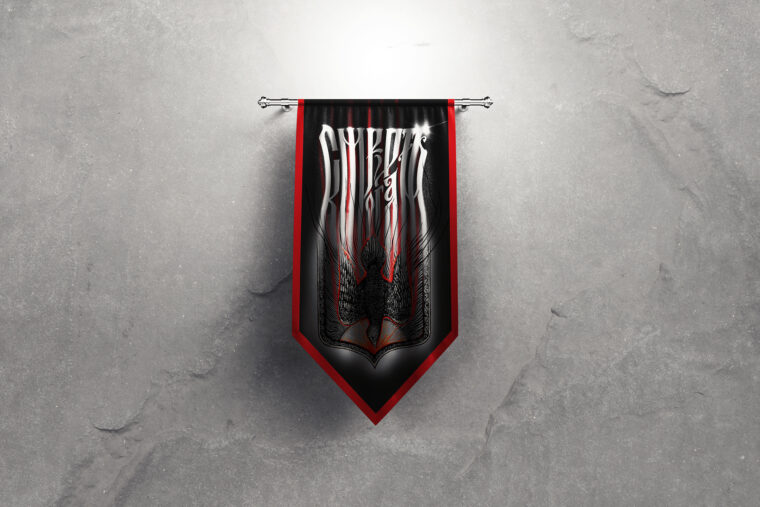
One of TAKTIKA’s most recognizable designs appeared before the brand itself was fully established.
I drew a falcon inspired by the princely symbolism of Kyivan Rus, the Rarog tradition and the Ukrainian Tryzub. I combined it with Egyptian mythology, placing the defeated Set beneath the attacking bird. In Egyptian mythology, Set was associated with disorder and the desert, while his conflict with Horus carried themes of power and sovereignty. In Ukraine in 2022, the image of a falcon defeating an enemy required little explanation.
A designer from Deep Digital Co — Worldwide painted the words SMERT VOROGAM — Death to the Enemies — in acrylic on canvas. We digitized the lettering and combined it with the falcon. The result was intentionally rough, preserving the physical character of the original brushwork rather than turning it into polished commercial typography.
TAKTIKA did not even have its own Instagram account at that point. I published the first T-shirts through my MZNTRP artist account, which already had more than ten thousand followers. Requests began arriving the same day. Because Ukrainian production was still being organized, the first batches used high-quality German and French blank garments. Approximately two weeks later, TAKTIKA received its own Instagram account. Within the first month, orders were arriving from the United States.
My longtime friend and client, Ukrainian musician Artem Pivovarov, was photographed wearing the Falcon design. We also developed additional visual projects with the Deep Digital Co team. The image appeared on clothing, patches, stickers and other objects. But its most important journey began when military personnel started carrying it into places where the brand had no direct presence.
Stories began returning from the front. In one case, a bullet damaged a Falcon patch while the soldier wearing it survived. Thousands of patches were produced, and tens of thousands of stickers were distributed with orders. They appeared on military equipment, vehicles, cases, walls and personal belongings. We had treated stickers as part of the visual identity rather than disposable advertising, but people began using them for their own purposes.
The Falcon was no longer simply a design printed on a T-shirt.
Full visual case: SMERTVOROGAM — Cultural Narrative Streetwear Design
The Limits of Ownership
Most companies try to control how their brands look and what their symbols mean. They create logos, establish visual rules, protect their designs and carefully manage public communication. This works while the symbols remain attached to products, advertising and official brand channels.
TAKTIKA began moving beyond those boundaries.
Soldiers exchanged patches. Customers attached images to personal belongings. People shared photographs and stories that had nothing to do with marketing campaigns. The meaning of these objects increasingly came from the people carrying them, not from the company that had produced them.
Some TAKTIKA customers are no longer alive. Their brothers-in-arms have kept patches, flags and other objects as reminders of people they lost. A piece of embroidered fabric can become something far more important than merchandise. It can represent friendship, belonging, survival or grief. No advertising campaign can manufacture that kind of meaning.
The design remains the same. What it represents changes.
Over time, TAKTIKA’s clothing and graphics appeared among musicians, artists, journalists, athletes, military personnel and civilians. Among them were Artem Pivovarov, mask artist Bob Basset, members of former world boxing champion Oleksandr Gvozdyk’s team, artist Hamlet Zinkivskyi, musician and serviceman Prozorowww, historian and sociologist Oleksii Kovzhun, and Pulitzer Prize-winning journalist Vasilisa Stepanenko. Some projects also involved military mask artist Plastmask, whose work has appeared with Muse.
These connections helped the brand become more visible. But there is a fundamental difference between a public figure wearing a T-shirt and a soldier carrying a patch into combat. The first can strengthen a brand’s reputation. The second can give an object a personal meaning that its creator could never predict.
A company can own a logo. It cannot own the memories people attach to it.
The object is entering a different system of meaning.
Full TAKTIKA case: ТАКТИКА — Legendary Ukrainian Brand
НЕНАВИСТЬ: Reducing an Emotion to a Sign
Another TAKTIKA project began with a different idea.
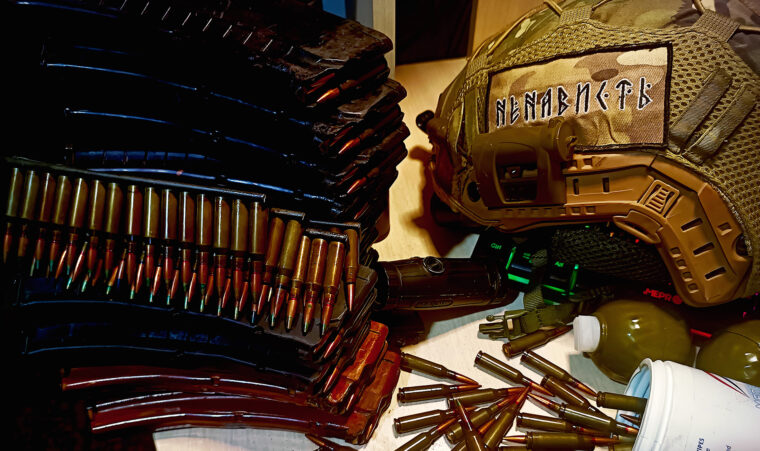
The Ukrainian word НЕНАВИСТЬ means HATE. During the full-scale invasion, hatred was not an abstract emotion. It existed in a society experiencing death, destruction, displacement and the loss of homes and families. I wanted to give that emotion a physical form without turning it into another complicated military illustration.
The first design was aggressive and visually dense. It contained illustrations, broken shapes and multiple graphic elements. I continued removing details, simplifying the composition until almost nothing remained.
Eventually, I removed everything except the word.
I reconstructed a rune-inspired typeface connected to TAKTIKA’s northern visual language. The result was harsh, simple and immediately recognizable. It did not need additional imagery to explain its meaning. The word itself carried the emotional weight.
Within two months, НЕНАВИСТЬ appeared on T-shirts, hoodies, caps, patches and stickers. Copies and imitations began circulating. Artists, soldiers and civilians wore the design, including people I had never met and had no connection with.
Then people began tattooing it onto their bodies.
Hundreds of military personnel adopted the design as tattoos on their chests, backs, necks and other parts of the body. At that point, it was no longer about buying clothing or supporting a particular brand. People were making the symbol a permanent part of their physical appearance and personal history.
I could no longer control where the design appeared, how it was reproduced or what it meant to each person. But that was precisely what made the project significant. A graphic created by one person had become a way for many others to express something they had experienced themselves.
The design did not create hatred. It gave an existing emotion a recognizable form.
Hate was not the trigger. It was the consequence.
Full visual case: НЕНАВИСТЬ — Apparel, Symbols, and Visual Pressure
Beyond Clothing
Over time, TAKTIKA became more than a clothing business. Its Instagram audience grew to more than 25,000 followers, including military personnel, veterans, volunteers and civilians supporting Ukraine. Before I stopped systematically collecting customer feedback, the account had accumulated approximately one thousand reviews.
These numbers were modest compared with international fashion brands. But TAKTIKA’s audience had something more important than size: a direct connection to the realities of the war.
Since the beginning of the full-scale invasion, I have used the platform to support volunteer initiatives. Hundreds of publications have shared requests for medical treatment, rehabilitation, tactical equipment, vehicles, drones, communication systems and humanitarian assistance. These requests are published without paid placement, usually after people contact us directly.
The same person who visits TAKTIKA to see a new collection may encounter a fundraising request from a military unit or someone who needs treatment. A clothing account has become an additional communication channel connecting people who need assistance with those who may be able to provide it.
This was never part of the original business plan. It developed because the audience had formed around shared experiences and concerns, not simply around fashion.
The commercial reality has also changed. New collections continue to appear, but sales have been minimal over the past year. Ukrainian military personnel and civilian customers face increasingly difficult economic conditions. I have no current plans to expand the business or force it into another growth cycle.
TAKTIKA continues to exist. Its value, however, can no longer be measured only through sales.
What Remains Outside the Design
Looking back, the most important part of TAKTIKA was not any individual collection or graphic. It was the combination of decisions made under circumstances in which ordinary business rules offered little guidance.
I created an identity while the country was entering a new phase of war. I built a production network without previous manufacturing experience, a factory or substantial infrastructure. I developed designs that eventually traveled far beyond the brand’s own communication channels. Each stage demanded different decisions, and none came with guarantees.
My later work on decision-making, responsibility and Anti-Coaching explores similar questions from a broader perspective. How do people continue working when reliable information is unavailable? How do organizations function under constant pressure? What happens when circumstances change faster than plans can be adjusted? TAKTIKA was not created to answer these questions. It was created while I was living through them.
The project showed me something that traditional branding rarely prepares its creators for. An image can leave the commercial environment in which it was designed and become part of someone else’s life. It can appear on a military vehicle, survive in a photograph, become a tattoo or remain among the possessions of a person who will never return.
Today, TAKTIKA exists in several forms. There is still a clothing brand, a production network and an audience. But there are also symbols that people have taken into their own lives, giving them meanings that I neither planned nor controlled.
A company can stop producing a T-shirt, close a store or discontinue a collection. It cannot remove a tattoo from someone’s body, erase a patch from a battlefield photograph or take away the memories attached to an object kept in honor of a dead friend.
That is not brand loyalty.
That is what happens when a brand becomes culture.
TAKTIKA — Instagram: https://www.instagram.com/ua.taktika